
ChatGPT guessed. Claude got it wrong. Alpha Boffin read the file.
One MP3, three AI tools, one question: which AI made this? Only Alpha Boffin gave an answer, and it found it in seconds.
Download Alpha Boffin freeThe challenge
A user had a mystery on their hands: an MP3 music demo, an upbeat country-pop track with a belted female vocal, acoustic guitar and an electric guitar solo, and no idea what AI tool had made it.
The question was simple:
“Do you know what AI app created this?”
It sounds easy, but it isn’t. There is no universal watermark, no visual branding and no single sound that reliably tells you which AI music platform produced a track. To most listeners, and apparently to most AI assistants, it’s just music.
The user uploaded the same MP3 to three AI tools: ChatGPT, Claude and Alpha Boffin. Only one answered the question.
What ChatGPT said
Asked “do you know what AI software created this?”, ChatGPT replied:
It then listed generic audio traits to listen for, such as breath sounds, delivery style and tonal consistency, and loosely linked them to unrelated platforms: ElevenLabs, Google Cloud Text-to-Speech, Amazon Polly and OpenAI voice models. It offered to do more, but only if the user first described what the audio sounded like.
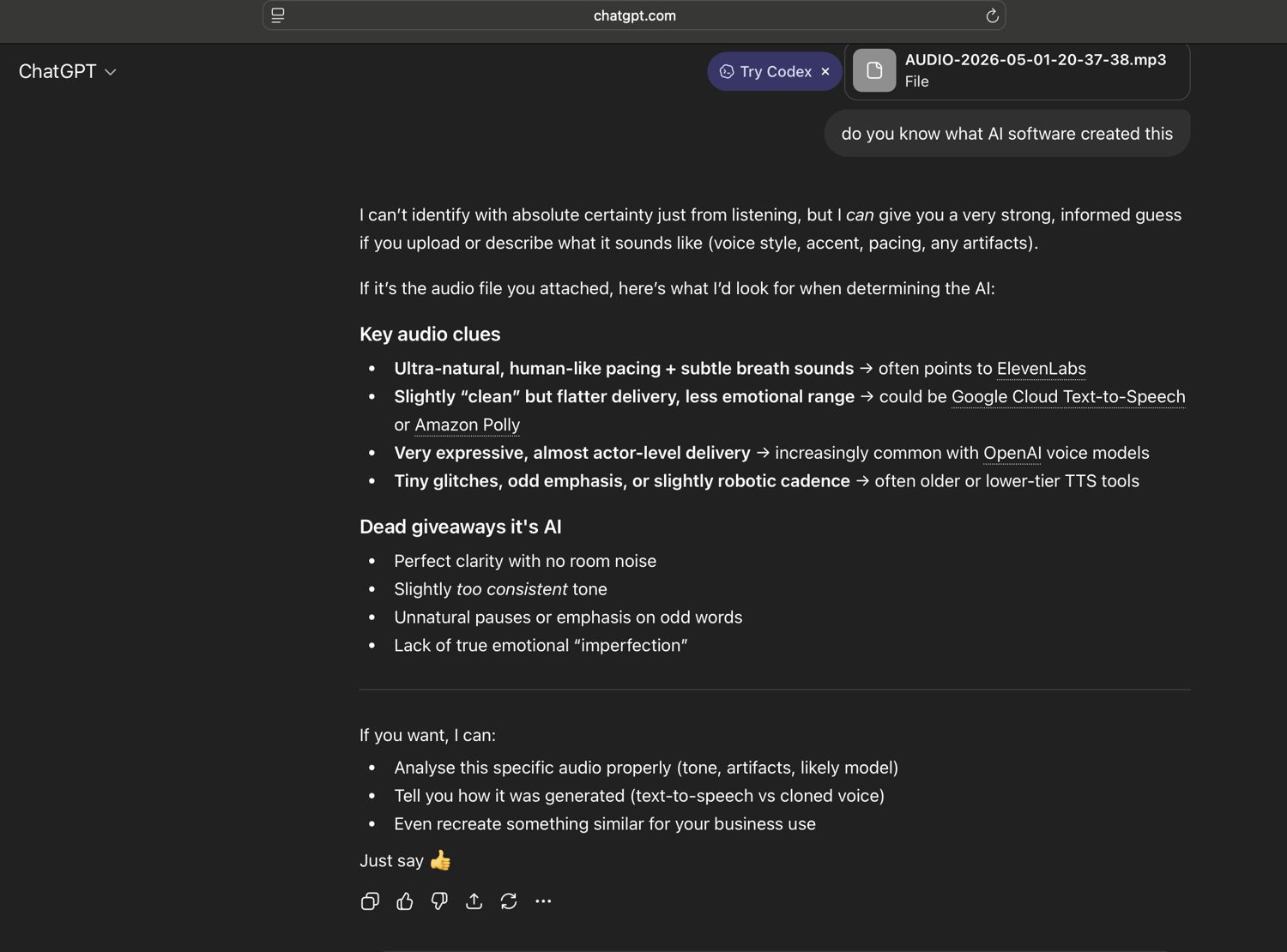
ChatGPT did not identify the origin of the file. At all. It never opened the MP3 or looked at its metadata. It gave a long, confident-sounding answer built on guesswork.
What Claude said
Given the same file and asked “do you know what AI app created this mp3?”, Claude replied:
It suggested three ways the user could find out for themselves, one of which was checking the file’s metadata. But instead of doing that, it misread the filename. It decided the format AUDIO-YYYY-MM-DD-HH-MM-SS was typical of WhatsApp voice messages, and suggested the file might simply be a voice note rather than an AI track.
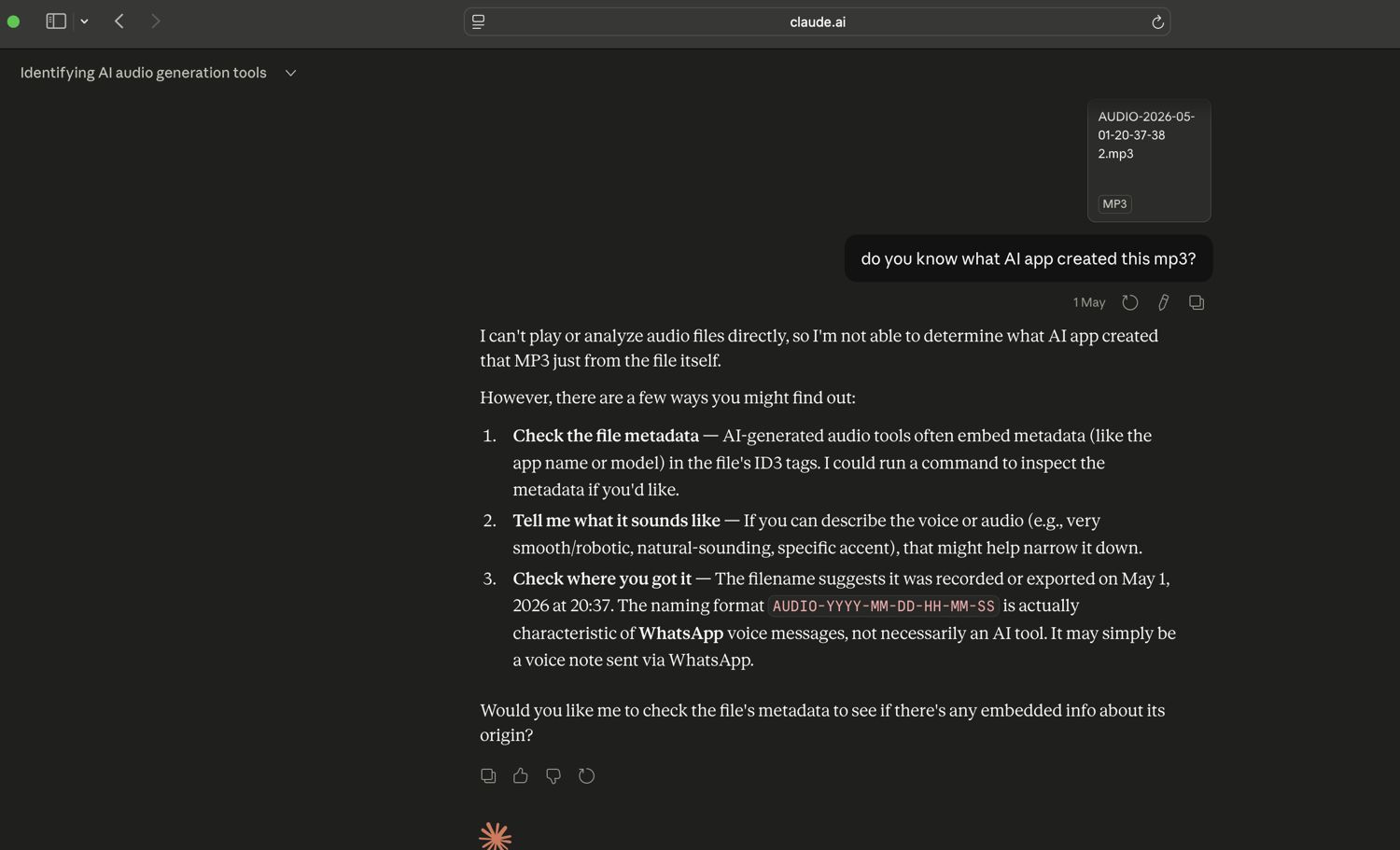
Claude did not identify the origin of the file either. The answer was sitting inside the metadata. Claude said it was worth checking, then didn’t check it, and sent the user in the wrong direction. Had they followed that lead, they would have given up on a false premise.
How Alpha Boffin solved it
Alpha Boffin took a completely different approach. No guessing, and no asking the user to describe what they could already hear. It ran a technical inspection of the file using ffprobe, a standard audio forensics tool, and read every tag embedded in the MP3.
It took seconds. Here is what it came back with:
Source identified: Suno AI
The MP3’s embedded comment tag contains this string, word for word:
| Field | Value |
|---|---|
| Platform | Suno AI (suno.com) |
| Creation date | 11 February 2026 at 13:35:55 UTC |
| Track ID | a7f2a111-fb43-4d81-9286-01bcb06b6385 |
| Duration | About 2m 46s |
| Sample rate | 48,000 Hz (stereo) |
| Bitrate | About 177 kbps |
| Encoder | Lavf 60.16.100 (FFmpeg, used by Suno for export) |
Alpha Boffin also described the track: a country-pop song built around the hook “I Only Ever Kiss You When I’m Drunk”, upbeat, with acoustic guitar, an electric guitar solo and a female AI vocal, very typical of Suno’s v3/v4 output in that genre. It pointed out that the track ID could be used to look the song up on Suno at suno.com/song/a7f2a111-fb43-4d81-9286-01bcb06b6385.
The user checked straight away. The song was public on Suno at exactly that address.
Got a file you can’t place?
Give it to Alpha Boffin and let it look inside, instead of guessing.
Download freeWhy it worked: Alpha Boffin treated the problem as a data task, not an audio recognition task. An MP3 isn’t just sound. It’s a container that carries titles, encoder details, creation dates and free-form comments. Suno, like many AI platforms, stamps its identity into every file it makes. Reading that isn’t a trick. It’s simply the right method, and it needed no guessing and no extra information from the user.
Why this matters
- For music creators and artists: if you receive an AI demo or sample and want to know where it came from, the answer may already be inside the file. You don’t need specialist software or a trained ear, just the right tool to look.
- For rights holders and legal teams: AI-generated files can carry provenance data added at creation, including platform, timestamp and a unique ID. That’s a verifiable trail, and could matter in disputes over AI-generated content. Check with a legal specialist for specific advice.
- For AI tool users: not all assistants approach a problem the same way. One that defaults to “I can’t do that”, or reaches for a speculative workaround, can miss a direct answer that was there all along. The difference wasn’t intelligence. It was method. Alpha Boffin went to the source. The others did not.
- For anyone working with AI media: as AI audio, images and video become common, tracing where they came from matters more. Reading what a file says about itself is simple, powerful and often overlooked, even by the best-known AI tools.
While ChatGPT guessed and Claude got it wrong, Alpha Boffin read the file and found the answer hidden in plain sight.
Based on a live interaction on 2 May 2026. Screenshots of the ChatGPT and Claude replies were captured at 00:18 the same day. The original Suno track was created on 11 February 2026 and is still publicly available on suno.com.